Your Cart is Empty


Let's cut through the jargon. A sinking fund is just a super-smart way to save for a big, specific expense you know is coming your way. Think of it as a dedicated pot of money set aside so you're not panicking when a major bill lands in your lap.

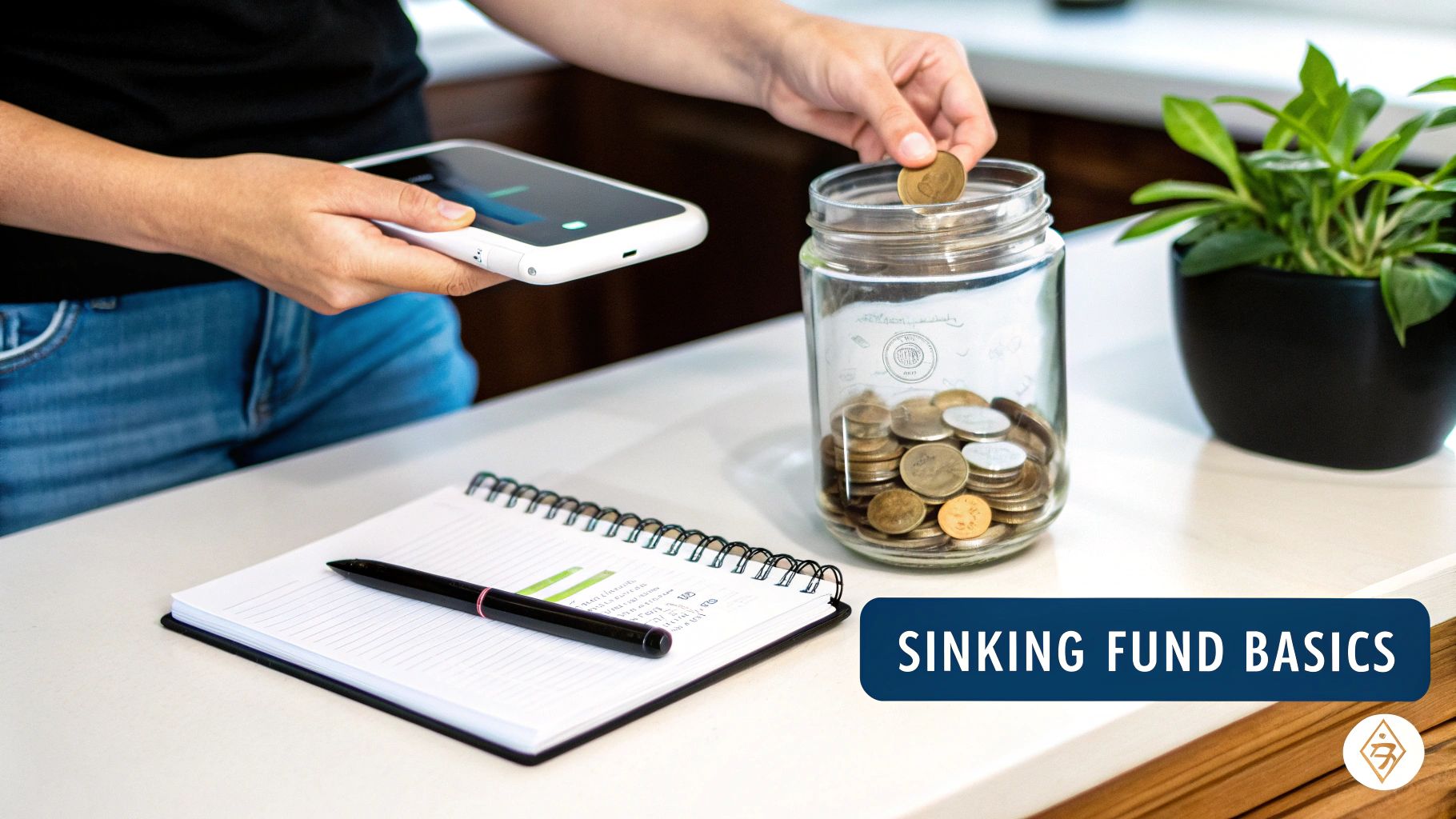
Okay, so you've probably heard the term, but what does it actually mean for your wallet? It’s all about being proactive instead of reactive. Instead of scrambling when your car suddenly needs new tires or your laptop gives up mid-semester, you’ll have the cash ready and waiting.
This isn't your typical emergency fund. An emergency fund is for total surprises, like a job loss or an unexpected medical bill. A sinking fund is for planned, predictable expenses, even if you don't know the exact date.
So what's the real difference? It all boils down to purpose.
Having both is a total game-changer for your financial health. It means you're prepared for both the expected and the unexpected, which seriously cuts down on money stress.
Implementing strategies like this is a cornerstone for anyone looking for practical steps on how to become financially stable. By planning ahead, you avoid going into debt for predictable costs.
This isn't just theory. For example, financial advisors often recommend that homeowners set aside 1-4% of their home's value each year for major repairs. For a $300,000 home, that’s between $3,000 and $12,000 a year just for things like a new roof or water heater.
By setting up these dedicated savings buckets, you are taking control. It's a key part of learning https://financialfootwork.com/blogs/my-money-blog/how-to-start-saving-money effectively because it gives every dollar a specific job. This is why understanding the formulas for sinking funds is so powerful. It gives you a clear roadmap to hit those big goals without breaking a sweat.
Alright, let's get into the good stuff: the actual math that makes a sinking fund work. Don't worry, I'll keep it straightforward. The main goal here is to figure out exactly how much cash you need to set aside regularly to hit a specific savings target down the road.
Think of it like planning a road trip. You know your destination (the total amount you need), and you have to figure out how much gas to put in the tank at each stop to make it there. The core formula for a sinking fund is your GPS for this financial journey.
Every good formula has its key players. For a sinking fund, you only need to get familiar with four simple variables. Once you know what they are, the rest is just plugging in the numbers.
These four pieces work together to create a clear financial roadmap. You tell the formula where you want to go (FV), how long you have to get there (n), and what the road conditions are like (i), and it tells you exactly what you need to do at each stop (PMT).
Now, let's look at the official equation. The sinking fund formula is a classic in finance because it neatly breaks down a big future goal into small, manageable steps.
The basic formula to find your payment is: PMT = FV / [((1 + i)^n - 1) / i].
You can get a much deeper look at the fundamentals behind these kinds of calculations in this deep dive into financial mathematics.
Let's use that dream vacation example to see how this actually works.
Scenario: You want to save $3,000 (FV) for a trip to Hawaii in two years (24 months, so n=24). You found a high-yield savings account that offers a 4.8% annual interest rate.
First, we need the monthly interest rate, not the annual one. To get 'i', you just divide the annual rate by 12: 0.048 / 12 = 0.004.
Now, you just plug everything into the formula. I know it looks a little intense, but any online calculator can do the heavy lifting. Based on these numbers, your required monthly payment (PMT) would be about $120.
That’s way more doable than trying to find a spare $3,000 all at once, right? That’s the real magic of using a sinking fund. It makes huge goals feel achievable.
Theory is great, but let's see how these formulas for sinking funds actually play out in the real world. This is where the concepts really start to click. We'll walk through three completely different scenarios to show you just how versatile these calculations are, whether you're managing your own cash or handling big corporate finances.
Imagine you’ve just landed your first "real" job, and it comes with a potential year-end bonus. Awesome, right? But that bonus is income, which means you're going to owe taxes on it. Getting slammed with a surprise tax bill in April is a massive buzzkill, so let's set up a sinking fund to get ahead of it.
Let’s say you’re expecting a $5,000 bonus in December. If we assume a combined federal and state tax rate of 25%, you'll owe $1,250 in taxes. You find out about the bonus in June, giving you a solid six months to save up.
The math here is straightforward: $1,250 / 6 = $208.33 per month. By setting aside just over $208 each month, you'll have the full tax amount ready to go when it's due. No stress, no last-minute scrambling, and no dipping into your emergency fund. This is a classic example of creating what’s known as a Net Income Liability (NIL) tax reserve, which is a super smart move for anyone with variable income.
A sinking fund transforms a potential financial shock into a manageable, predictable expense. It's about paying yourself first, even when the money is technically for the tax man.
Now, let's switch gears and look at a small business. Picture a local coffee shop that knows it needs to buy a new, top-of-the-line espresso machine in three years to keep up with the morning rush. That machine is going to cost $15,000.
Instead of taking out a loan and paying interest, the owner decides to use a sinking fund. They open a business high-yield savings account that earns a decent 3.6% annually.
Plugging these numbers into our sinking fund formula, we find that the owner needs to deposit $400.35 each month. Over three years, their total out-of-pocket contribution will be $14,412.60. The remaining $587.40 comes from the magic of compound interest. This is a perfect illustration of how planning ahead saves a business real money and helps it grow without taking on debt. It’s a key part of how you can learn to dream it, achieve it: setting and reaching your financial goals when running a company.
Here’s a simple visual to help you remember the process of using these formulas.
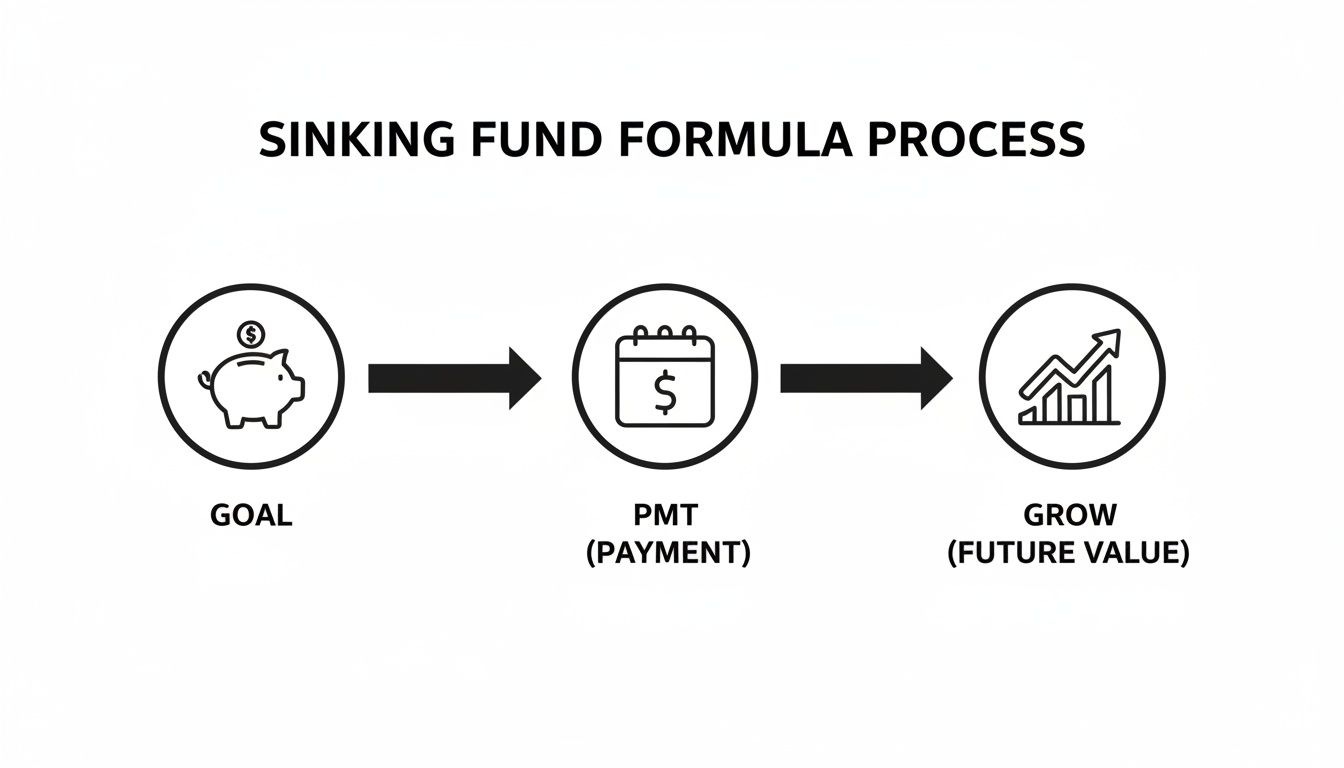
This flow shows how you start with a specific goal, figure out your periodic payment (PMT), and let the fund grow over time until you hit your target.
To give you an even clearer picture of how these variables interact, here's a quick comparison of a few different savings goals. Notice how the monthly payment changes based on the timeline and interest rate.
| Savings Goal | Target Amount (FV) | Timeframe | Interest Rate (Annual) | Required Monthly Payment (PMT) |
|---|---|---|---|---|
| Down Payment on a Car | $5,000 | 2 years | 4.0% | $200.16 |
| Home Renovation Fund | $25,000 | 5 years | 3.5% | $385.01 |
| Small Business Expansion | $100,000 | 7 years | 5.0% | $985.34 |
As you can see, a longer timeframe and a higher interest rate can significantly reduce the amount you need to save each month. It really highlights the power of starting early and making your money work for you.
Finally, let's look at a more complex, high-stakes example. Imagine a professional sports team needs to buy out a player's contract in five years. The buyout clause is a staggering $10 million.
This is a massive future liability that could cripple cash flow if unplanned. The team's financial officers would absolutely create a sinking fund to handle this. They’d likely invest the funds more aggressively to get a better return, let's say an average of 6% annually.
Using the formula, the team needs to set aside $143,328 per month. While that’s a huge number for most of us, for a pro sports franchise, it’s a manageable operational expense. Without the fund, they’d be staring down a $10 million cash crisis.
Beyond sinking funds, understanding other powerful financial metrics can sharpen your long-term planning. For example, knowing how to use an Internal Rate of Return (IRR) calculator is invaluable for evaluating investment opportunities. These examples just go to show that no matter the scale, from a few hundred bucks to millions, the core principle is the same: break a big future cost down into small, consistent actions today.
Sinking funds might feel like a modern financial hack you'd see on social media, but the concept is anything but new. This strategy has been around for centuries, used by entire governments and massive corporations to tackle gigantic debts.
This isn't just a clever budgeting trick; it's a financial tool that has been pressure-tested at the highest levels. Understanding its history gives you some powerful context for the money moves you’re about to make and proves just how solid the principles are.
Let's rewind to the 1700s. The British government was staring down a mountain of national debt and needed a smart, sustainable way to dig themselves out. Their solution? One of the first large-scale uses of a sinking fund, and it was a massive success.
Under Prime Minister William Pitt the Younger, they established a protected fund in the 1780s. Between 1786 and 1793, they poured £8 million into it. By strategically reinvesting the interest, they managed to reduce the national debt by over £10 million. That's a 125% return on their contributions, a stunning example of how consistent saving and compounding can work wonders. You can dive deeper into this fascinating strategy by reading about the origins of the sinking fund.
This screenshot from a historical ledger shows the British Sinking Fund's progress from its start in 1786.
You can literally see how the consistent contributions and reinvested earnings created a snowball effect over time.
This idea wasn't just for governments, either. Sinking funds became a cornerstone of the great industrial booms. Think about the railroads stretching across the United States in the 1800s. Laying all that track and buying locomotives cost an absolute fortune.
Railroad companies issued bonds to raise the cash, but they had to convince investors they'd get their money back. The sinking fund was their answer.
By setting aside a slice of their revenue each year specifically to repay those bonds, they built trust and confidence with their investors. This steady, planned-out approach made it possible to fund the enormous infrastructure projects that literally built the country. It just goes to show that whether you're saving for a new laptop or funding a transcontinental railroad, the core idea of a sinking fund is tried and true.

Alright, you've seen the history and crunched the numbers with the formulas for sinking funds. Now it's time for the fun part: actually setting them up so they become a seamless part of your life. This is where all that planning turns into real, tangible progress.
Think of this as your practical playbook. We're going to walk through the simple, actionable things you can do to get your funds started, keep them organized, and make sure they’re ready for you when life inevitably throws a curveball.
First things first, you need a dedicated spot to stash this cash. Whatever you do, don't just let it pile up in your main checking account. That's a surefire recipe for accidentally spending your "New Car Fund" on takeout and online shopping.
Your best move is to open a separate high-yield savings account (HYSA) for your sinking funds. HYSAs are fantastic because their interest rates are way better than what traditional savings accounts offer, which means your money grows a little faster all on its own. It also creates a mental and digital barrier, making you think twice before dipping into those funds for something unrelated to your goal.
The key is to separate and automate. By setting up automatic transfers to a dedicated account, you start treating your savings goal just like any other bill. It becomes a non-negotiable expense that gets paid first.
If you’re juggling multiple sinking funds, some online banks let you create digital "buckets" or sub-accounts within a single HYSA. This makes tracking each goal incredibly easy without having to open a dozen different accounts.
This might sound a little cheesy, but trust me, it works. Don’t just label your accounts "Sinking Fund 1" and "Sinking Fund 2." That’s boring and completely uninspiring.
Instead, give each fund a name that actually connects you to the goal. You’re far more likely to stay motivated when you open your banking app and see "Dream Hawaii Vacation" or "Future Puppy Fund." It turns a chore into an exciting countdown.
Here are a few quick tips to keep that momentum going:
You don't need fancy, expensive software to manage your funds. Honestly, a basic spreadsheet is all it takes to stay organized and see exactly how far you've come.
Here’s a simple structure you can build in a few minutes using Google Sheets or Excel:
| Sinking Fund Goal | Target Amount | Monthly Contribution | Current Balance | Percent Complete |
|---|---|---|---|---|
| Hawaii Trip 2025 | $3,000 | $125 | $750 | 25% |
| Holiday Gifts 2024 | $800 | $80 | $400 | 50% |
| New Laptop Fund | $1,500 | $100 | $300 | 20% |
A simple table like this gives you a clear snapshot of where you stand with each goal. It's a powerful visual that shows your hard work is actually paying off in real time.
And finally, remember to stay flexible. If your income changes or a goal suddenly becomes less of a priority, don't be afraid to adjust your contributions. The whole point of a sinking fund is to reduce stress, not add more of it. For more on this, you can learn how to determine the best budget percentages for you and keep your entire financial picture in balance.
Got more questions? You're not alone. Once you start digging into the math behind saving, a few things usually pop up. Here are some of the most common questions people ask about sinking funds and the formulas that power them.
We'll give you clear, no-fluff answers to help you feel totally confident with your plan.
Totally. This is a super common question. Let's say you want to save for "home repairs." You don't know if you'll need a $500 plumber or a $5,000 new water heater.
In this case, you can't use the precise formulas for sinking funds to get an exact monthly payment. Instead, you set a reasonable savings goal based on what you can afford and what experts suggest. Financial advisors often say to save 1-4% of your home's value annually for maintenance, so that’s a great starting point.
This happens all the time, especially with high-yield savings accounts. When the rate goes up, it's great news. You'll hit your goal a little faster or you could even slightly lower your monthly contribution.
If the rate drops, you have two choices:
Don't stress too much about small fluctuations. The most important thing is to stay consistent with your contributions. The habit of saving regularly is way more powerful than a fraction of a percent in interest.
Think of it like this: a regular savings account is a general "just-in-case" bucket. It doesn't have a specific job. A sinking fund is a savings account with a very specific mission and a deadline.
The biggest difference is the mindset. Giving your money a specific purpose, like "New Laptop Fund," makes you way less likely to raid it for random purchases. It’s all about intentionality. Using a formula to calculate your deposits just adds another layer of focus, turning a vague wish into a concrete plan.

Ready to build a solid financial plan beyond just savings? The team at Financial Footwork provides expert coaching to help you master your money with confidence. Learn how our programs can empower you to take control of your financial future by visiting us at https://financialfootwork.com.