Your Cart is Empty


So, what is financial coaching, really? It's basically like getting a personal trainer for your money. A coach helps you dig into your financial habits, set goals you can actually hit, and build a solid plan to get your money life on track.

Let's get one thing straight: a financial coach isn't some stuffy advisor talking down to you about stocks and investments you don't understand. It’s way more personal and hands-on than that. Think of it less like a lecture and more like a partnership.
The whole point is to empower you. Instead of just telling you what to do, a coach helps you figure out the how and the why behind your money decisions. It’s a collaborative process focused on building your confidence so you can make smart choices on your own, long after your sessions are over. This approach helps you build a healthier relationship with your finances, focusing on your behaviors and mindset to create lasting change.
To get a clearer picture, here’s a quick summary of what financial coaching is all about.
| Key Aspect | Description |
|---|---|
| What It Is | A collaborative, educational partnership focused on financial literacy and behavior change. |
| Main Focus | Building healthy money habits, improving mindset, and creating actionable plans for your goals. |
| Who It Helps | Individuals, couples, and teams who want to gain control over their day-to-day finances and build confidence. |
Essentially, it's about learning the fundamentals so you can manage your money with skill and less stress.
The easiest way to think about it is like hiring a personal trainer at the gym.
A financial coach does the exact same thing, but for your wallet. They work with you to build a personalized plan, teach you the fundamentals, and keep you motivated. You'll learn how to build your financial "muscles" so you can handle money challenges with confidence. A great place to start understanding this role is by learning more about what a money coach can do for you and your specific goals.
To make it super clear, let's break down the core of financial coaching. It’s not about getting quick, magic-bullet solutions. Instead, it’s about a steady process of building good habits that stick.
Financial coaching is a supportive, educational process where you work one-on-one with a professional to build financial literacy, develop healthy money habits, and achieve your personal financial goals. It's about behavior change, not just investment picks.
This means the focus is squarely on your actions and mindset. A coach helps you see where your money is going, identify spending triggers, and create a budget that actually works for your lifestyle. They won't judge you for past mistakes. Instead, they’ll help you learn from them and move forward. It’s all about creating a positive and proactive financial future, one step at a time.
You’ve probably heard “financial coach” and “financial advisor” used interchangeably and figured they’re the same thing. It’s a common mix-up, but they actually play very different roles. Getting this straight is the key to understanding who you should really be talking to about your money.
Think of it this way: a financial advisor is like a doctor. You go to them with a specific issue, maybe you inherited some money or need to invest your 401(k), and they prescribe a solution. They’ll often tell you exactly which stocks or funds to buy, focusing on the “what” of your money.
On the other hand, a financial coach is more like your personal trainer at the gym. They’re not just handing you a workout plan and walking away. They’re right there with you, teaching you the proper form, pushing you to stay motivated, and helping you build healthy habits that stick. They focus on the “how” and “why” behind your money decisions.
The biggest difference really comes down to their primary focus. Advisors are typically all about products and investments. Their main goal is to manage your assets and help you grow your wealth through specific financial instruments. They’re the experts you see when you have a chunk of money and need to know where to put it.
Coaches are all about your behavior. They dig into your relationship with money. Why do you overspend on certain things? What’s holding you back from saving consistently? They work with you to build a budget you can actually live with, create a plan to tackle debt, and lay a solid foundation for your financial life.
This decision tree can help you quickly see which path might be the right fit for where you are right now.
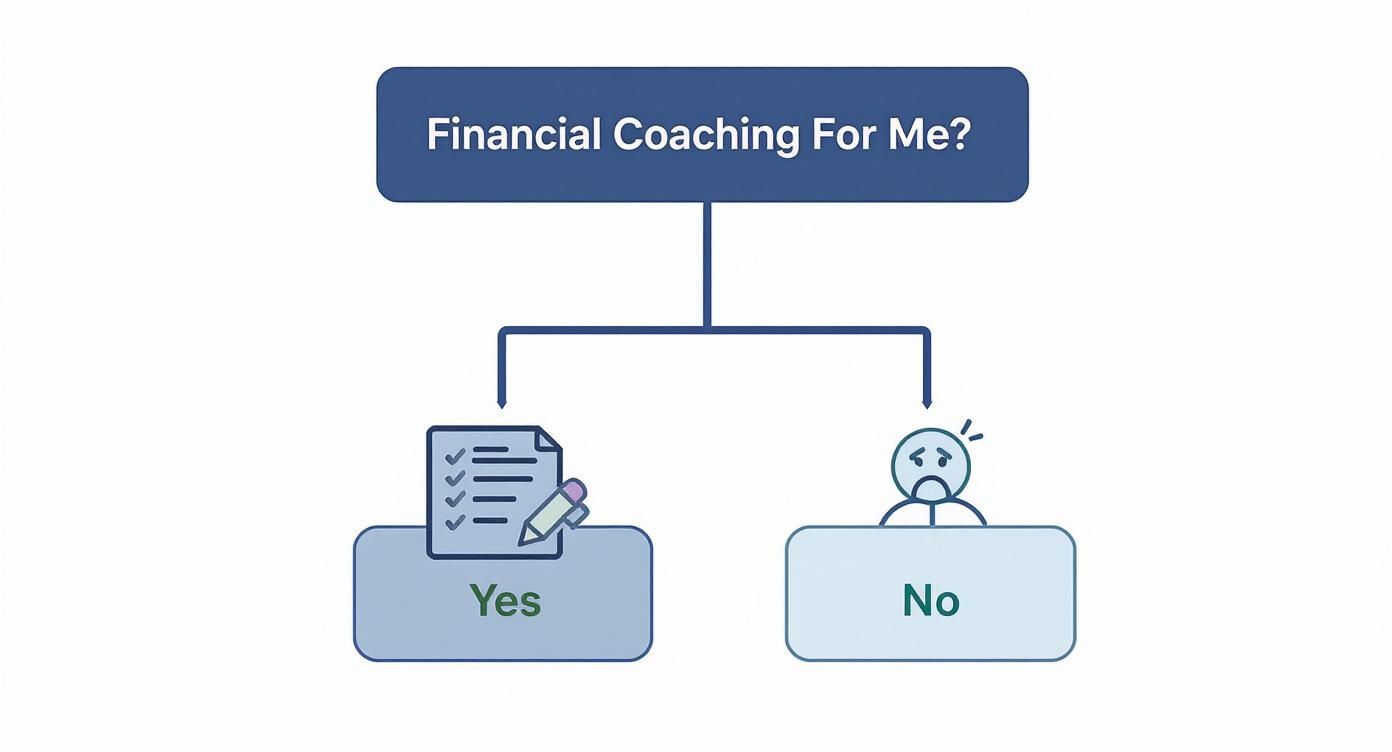
As the flowchart shows, if your goal is to set and achieve personal financial goals by changing your habits, a coach is the way to go.
To make it even clearer, let’s break down the key differences side-by-side. Seeing it all laid out like this really highlights how each professional tackles a different part of your financial world.
| Feature | Financial Coach | Financial Advisor |
|---|---|---|
| Main Goal | Changing your financial behaviors and building good habits. | Managing and growing your investments and assets. |
| Typical Focus | Budgeting, debt reduction, saving strategies, money mindset. | Investment management, retirement planning, estate planning. |
| How They're Paid | Usually a flat fee, hourly rate, or monthly subscription. | Often a percentage of the assets they manage (AUM) or commissions. |
| Credentials | May have certifications like AFC® or FFC®. Focus is on coaching skills. | Must have specific licenses (like Series 7 or 65) to sell securities. |
| Best For You If... | You need help getting out of debt or want to build better day-to-day money habits. | You have money to invest and need expert help managing a portfolio. |
Ultimately, one isn't better than the other; they just serve different purposes. You might see a financial coach to get your debt under control and build an emergency fund. Then, once you've built up some savings, you could go to a financial advisor to figure out the best way to invest it for the long term.
It's not about choosing one forever. It's about finding the right professional for the financial season you're in right now.
A lot of people actually work with both at different stages of their financial journey. A coach helps you get the fundamentals right so you're in a great position to work with an advisor down the road. It’s all about building a strong financial team that supports your goals, whatever they may be.
So, who really needs a financial coach? It’s easy to assume coaching is just for people who feel like they’re drowning in debt, but that’s barely scratching the surface.
Truthfully, financial coaching is a game-changer for a whole range of people in all kinds of situations. It isn't just a rescue mission. It’s also about building something strong from the ground up, whether you're starting with a little or a lot.
Let's look at a few real-world examples where coaching makes a massive difference. You might be surprised who’s getting in on this.
College Athletes: With the new NIL (Name, Image, and Likeness) deals, student-athletes are suddenly handling serious money for the first time. A coach helps them understand taxes, budgeting, and how to make that first big check last way beyond their college years. It’s about setting up a solid financial playbook for the future.
Companies and Their Employees: A lot of forward-thinking companies are now offering financial coaching as a wellness perk. Why? Because money stress is a huge productivity killer. When employees feel more in control of their finances, they're happier, more focused, and less likely to be distracted at work.
This isn’t just a niche trend. The demand for all types of professional coaching is exploding. The professional coaching industry in the United States is on track to become a $16 billion market, with over 232,000 coaches helping people with their lives, health, and finances. That number has more than doubled since 2016, which shows just how many people are investing in themselves.
It’s not just students and corporate teams, either. Professional athletes, for instance, face a unique set of financial pressures. Their careers can be short, and their income is often front-loaded into a few high-earning years. A financial coach is crucial for helping them manage huge signing bonuses, plan for a long life after sports, and avoid the common financial pitfalls that have tripped up so many pros before them.
But you don’t need a multi-million dollar contract to benefit. Anyone ready to get serious about their money can see huge wins.
A financial coach is a powerful tool for anyone ready to level up their money skills, whether you're just starting out, navigating a major life change, or finally ready to build the financial future you want.
Maybe you just got a promotion and want to make the most of your new salary. Or maybe you and your partner are trying to finally get on the same page about your financial goals. These are perfect scenarios for a coach. They provide a non-judgmental space to talk things through and build a plan that works for you.
Still wondering if the investment makes sense for your situation? You might be interested in our deep dive on whether a financial coach is worth it for you.
If you're thinking about financial coaching, you might be picturing a stuffy meeting where someone lectures you about every latte you've ever bought. Let's clear that up right now. A real coaching session is nothing like that; it's more like a productive, collaborative chat with someone who's 100% on your team.
The whole journey kicks off with a simple conversation. It's all about figuring out where you are with your money today and, more importantly, where you want to go. There’s no judgment here, just a genuine effort to understand your story.

The first step is what we call the 'discovery' phase. This is where you and your coach just talk. You’ll cover your goals, some of your money fears, and your current habits. It’s a safe space to be totally honest without feeling embarrassed or put on the spot.
Think of your coach as a guide. They’re there to listen and ask the right questions, the ones that help you see the full picture of your financial life. This initial chat is super important because it sets the foundation for everything that comes next.
It’s all about getting to the root of your financial behaviors so you can start making real, lasting changes.
After that discovery chat, you’ll work together to build a personalized roadmap. This isn't some generic, one-size-fits-all template. It’s a step-by-step guide designed specifically for your life and your goals.
Your coach will bring helpful tools and frameworks to the table, making things like creating a budget or planning for debt payoff feel way less overwhelming. The whole point is to create a plan that feels totally doable, not restrictive.
What is financial coaching all about at this stage? It's a team effort. The coach provides guidance and accountability, but you are always the one in control. Your plan has to work for you.
This collaborative approach is key because it ensures you feel ownership over your financial future. You're not just being told what to do; you're an active participant in creating the strategy. Honestly, that's what makes sticking to the plan so much easier in the long run.
So, what happens from one meeting to the next? It's a continuous cycle of planning, acting, and checking in. Each session builds on the last one, keeping you moving forward with momentum.
A typical coaching relationship might follow a structure like this:
This structured yet personal approach is what makes coaching so effective. It’s not just about getting information; it’s about implementation and support. To see how this applies to specific challenges, you can learn more about how a coach tackles everything from student loans to retirement planning and helps you stay on track. The entire experience is built around support and making sure you feel confident every step of the way.
So, you're on board with the idea of financial coaching. Awesome. But how do you find someone you can actually trust with your money story? The whole world of coaching is blowing up, so you really need to know what to look for before you jump in.
The coaching industry, which includes financial coaching, was valued at around $6.25 billion in 2024 and is expected to hit $7.31 billion by 2025. With the number of active coaches doubling from 71,000 in 2019 to over 145,000 in 2024, there are a lot more options out there. This growth is great, but it also means you have to be smart about who you choose.

First things first, you want to see some proof that they know their stuff. While financial coaching isn't as heavily regulated as financial advising, there are still important credentials to look for. Think of it like checking a restaurant's health score before you eat there.
Look for certifications from respected organizations. A big one is the Accredited Financial Counselor (AFC®) from the Association for Financial Counseling & Planning Education (AFCPE®). This tells you the coach has gone through some serious training and passed a tough exam covering personal finance.
But it’s about more than just some letters after their name. A quick online search can tell you a lot. Check out their LinkedIn profile, read reviews, and see if they have a professional website that clearly explains their services.
This part is super important. You want to find a coach who acts as a fiduciary. That’s a fancy word, but it just means they are legally and ethically required to put your best interests ahead of their own.
A fiduciary coach won’t push you to buy specific products because they get a kickback. Their only goal is to help you succeed. This creates a relationship built on trust, which is exactly what you need when you're talking about something as personal as money.
The right coach is your advocate. They're in your corner, and their recommendations are based solely on what's best for your financial well being, period.
This commitment to your best interest is a non-negotiable. It ensures the advice you get is unbiased and tailored to your unique situation, not someone else's sales quota.
Finding the right person is also about finding the right personality fit. You’re going to be sharing some personal stuff, so you need to feel comfortable. Most coaches offer a free introductory call, and you should totally take advantage of it.
Treat it like an interview where you’re the one hiring. Here are a few questions you should definitely ask:
For those curious about the industry from the provider's side, learning about starting an online coaching business can also offer interesting insights into what makes a good practice. At the end of the day, picking a financial coach is a big decision. Take your time, do your homework, and trust your gut to find someone who you click with.
Alright, let's get into the questions you're probably asking yourself right now. Opening up your financial life to someone new is a big step, and it’s completely normal to have some reservations. We'll give you straight, simple answers to help you figure out if this is the right move for you.
You're not alone in wondering about these things. Most people have the same concerns before they dive in.
This is always the first question, right? And it’s a big one. The cost of financial coaching can vary, but it’s usually way more straightforward than what you’d find with a traditional financial advisor.
Instead of charging a percentage of your assets, most coaches use a much simpler pricing model. This keeps everything transparent, so you always know exactly what you’re paying for.
Here are the most common ways coaches charge:
The exact price really depends on the coach's experience and what they include. The key is to see it as an investment in your skills and confidence. You aren't just paying for sessions; you're building a foundation that will pay you back for years.
This is probably the single biggest hurdle for most people, and it’s completely understandable. Money is incredibly personal, and it can feel really vulnerable to talk about struggles or past mistakes. But here’s something you need to know.
A good financial coach is a judgment-free zone. Seriously. Their job isn’t to shame you; it’s to help you move forward. They've heard it all before and know that everyone’s financial journey has its own bumps and detours.
Your financial coach is on your team, not in the stands judging your performance. They are there to provide support, guidance, and a safe space for you to be honest about your money without fear.
Think of it this way: you wouldn't be embarrassed to tell a personal trainer you're out of shape, right? That's why you hired them in the first place. The same logic applies here. A coach is there to meet you exactly where you are and help you get where you want to go. The entire process is confidential and focused on your future, not your past.
Another great question, and the honest answer is: it depends. There’s no magic number because financial coaching isn't a one-size-fits-all program. The timeline is completely tailored to you and what you want to achieve.
Someone who just wants to get a handle on their monthly spending might only need a few sessions over a couple of months. On the other hand, a person with a more complex goal, like paying off a large amount of debt or saving for a major life event, might work with a coach for six months to a year.
Here’s a general idea of what to expect for different goals:
The beauty of coaching is its flexibility. You and your coach will figure out a timeline that makes sense for your goals and your life. The focus is always on making steady, sustainable progress, not on rushing to a finish line. The real goal is to build habits that stick with you long after your coaching sessions are over.

Ready to stop stressing about money and start building a more confident financial future? At Financial Footwork, our coaches are here to provide the practical guidance and support you need to make real progress. Learn more about our programs and schedule a call today!