
Your Cart is Empty


When most people hear “asset protection planning,” they probably think of billionaires with private jets and hidden vaults. But it's actually way more practical than that. It's really just about creating a smart, legal shield around the stuff you’ve worked hard for, like your house, savings, or business, from unexpected lawsuits or debts.
It’s about playing defense so you don't lose everything when life throws a curveball.


One of the biggest myths out there is that you don't need to think about asset protection until you're a millionaire. That's a huge mistake. The truth is, if you have anything worth protecting, you're a potential target. Lawsuits and money troubles don't just happen to the wealthy.
Imagine a simple fender bender that turns into a massive lawsuit, one that goes way past your auto insurance limits. Or what if your side hustle hits a rough patch, and suddenly creditors are looking at your personal checking account to cover business debts? These aren't wild scenarios; they happen every single day.
This is where a solid asset protection plan comes in. It's not about hiding money or doing shady stuff. It’s about using totally legal structures to organize your finances and lower your risk.
A good plan acts like a financial fortress. It makes your wealth a much harder target for creditors, which can discourage people from filing sketchy lawsuits before they even start. It’s about control, not hiding things.
So, what kinds of risks are we really talking about here? Everyone's situation is different, but a few common weak spots pop up all the time.
The goal is to get ahead of these potential problems. Think of it less as a legal strategy and more as a form of financial self-care. A good plan makes sure that one bad day doesn't wipe out years of hard work.
More and more people are catching on to how important this is. It's all about protecting your wealth from life's curveballs like lawsuits, creditors, or even a messy divorce. Strategies like trusts and LLCs make that possible.
Just look at the numbers. The global estate planning services market, a key part of asset protection, was valued at USD 297 million in 2024. It’s expected to jump to USD 503 million by 2032. You can learn more about the growth in estate planning services and see how this is becoming a big trend. This isn't some niche financial trick anymore; it's becoming a mainstream way for people to lock down their futures.
Alright, so where do you actually start with asset protection? It’s way less complicated than most people think. Your first line of defense is built with tools you probably already have. You just need to know how to use them the right way.
Think of it like setting up your base in a video game before the main quest starts. These basic layers are the easy wins, creating a strong shield around your stuff before you even think about more advanced strategies like LLCs or trusts.
We’re talking about simple, smart moves that can make a huge difference. It's all about being proactive, not necessarily about spending a ton of money or hiring a legal team right away.
Your insurance policies are your front-line soldiers. Seriously. Before a lawsuit can even get close to your savings account or your house, it has to get past your insurance.
But here’s the problem: most people just buy the minimum coverage required by law and call it a day. That’s a huge gamble. If a car accident leads to a lawsuit that goes past your policy limits, guess where they’re coming for the rest of the money? Your personal assets.
A simple fix for this is an umbrella policy. It's extra liability insurance that kicks in when your regular auto or home insurance gets maxed out. For a pretty low cost, you can add $1 million or more in coverage. This one move is one of the best asset protection steps you can take.
Think of your umbrella policy as a financial bodyguard. It stands between a major lawsuit and your life savings, giving you an essential buffer that standard policies just don't offer.
Next up are your retirement accounts, like a 401(k) or an IRA. These aren't just for when you're older; they're also powerful protection tools right now.
Federal and state laws often give these accounts special protection from creditors. This means that in many situations, even if you lose a lawsuit or file for bankruptcy, creditors can’t touch the money you’ve saved in qualified retirement plans.
Globally, this is a massive strategy. Pension assets were expected to hit a record USD 69.8 trillion worldwide by the end of 2024, showing just how important these accounts are for protecting wealth.
This is why always contributing to your retirement accounts is a double win. You're building wealth for the future and protecting it today. If you're looking for ways to boost your contributions, our guide on how to start saving money has some practical tips.
How you legally own something, or how it's "titled," matters a lot. It can be the deciding factor in whether an asset is up for grabs in a lawsuit filed against you.
For example, owning a home as Tenants by the Entirety (a special status for married couples in some states) can shield it from the creditors of just one spouse. If only one of you gets sued, the house might be completely off-limits.
On the other hand, a common mistake is adding a child’s name to your house deed as a joint owner. It seems like an easy way to pass it on, but it can backfire badly. If your child gets into a car accident or a messy divorce, your home is now partly their asset and could be targeted.
Whether it’s for a small business or personal property, the way you structure ownership is key. When looking at something like incorporation vs sole proprietorship in Canada, the main idea is creating legal separation and limiting how much you can lose. Getting these basic layers right is your first big step toward real financial security.
To pull it all together, here's a quick look at the basic tools for asset protection and what they actually do for you.
| Protection Tool | What It Protects You From | Who It's For |
|---|---|---|
| Umbrella Insurance | Lawsuits that go beyond your standard auto/home liability limits. | Anyone with assets that are worth more than their basic insurance coverage. |
| Retirement Accounts | Creditors in bankruptcy or lawsuits (up to certain legal limits). | Anyone saving for retirement in a 401(k), IRA, or similar plan. |
| Correct Asset Titling | Creditors of just one co-owner (like one spouse or a child). | Married couples, property owners, and parents planning their estate. |
These three tools are the foundation of a solid asset protection plan. Master them first, and you'll be in a much stronger position to handle whatever comes your way.

So you’ve maxed out your insurance policies and are contributing to your retirement accounts. That’s a great start. But now it’s time to move beyond the basics and into more powerful, structural layers of defense.
This is where we get into business entities and trusts. They might sound intimidating or like something only for the super-rich, but they're incredibly practical tools for anyone who owns a business, runs a side hustle, or just wants to build a serious wall around their hard-earned assets.
Think of it like this: insurance is your shield. Retirement accounts are your armor. But business structures and trusts? That’s the fortress you build around your entire financial life.
This one is a must for any entrepreneur, freelancer, or side hustler. One of the single biggest financial mistakes I see is people mixing their business and personal finances. Without a legal entity separating the two, your personal assets like your home, car, and savings are totally exposed if your business gets sued or takes on debt.
This is exactly what a Limited Liability Company (LLC) is for. The name says it all.
An LLC creates a legal firewall between you and your business. It basically tells creditors and courts, "My business is its own legal 'person,' and its debts are not my personal debts." This separation is so important. Understanding different legal frameworks, like various Canadian business structures, can also give you a wider view on how these ideas are used around the world.
An LLC is one of the cleanest ways to protect your personal life from your professional risks. If your business faces a lawsuit, the claim is against the LLC's assets, not your personal savings account.
Let's make this real. Say you're a graphic designer doing freelance projects on the side. You land a big contract, but a misunderstanding leads to a major issue, and the client decides to sue you for damages.
Setting up an LLC isn't as complicated as you might think, but it definitely needs to be done correctly to make sure that legal wall is strong enough to hold up when tested.
Okay, let's talk trusts. Forget the confusing legal stuff from movies. A trust is just a private legal agreement you create to hold your assets. You put your assets into a legal "box," then you write the rules for how that box is managed and who gets to benefit from it.
While there are many types of trusts, two categories are most important for asset protection: revocable and irrevocable.
A Revocable Living Trust is flexible. You control it completely and can change or cancel it anytime. Its main job is to help your estate avoid probate, which is the long and public court process that settles your stuff after you pass away. It doesn't offer much protection from creditors while you're alive, but it's a key part of smart estate planning.
An Irrevocable Trust is the heavyweight champion of asset protection. Once you transfer assets into an irrevocable trust, you give up control and can't easily take them back. By doing this, you're officially removing them from your ownership, which puts them beyond the reach of potential future creditors. It's a big move, but it offers the highest level of protection available for those assets.
This isn't some obscure strategy; it's like what major corporations do every day. The global retail asset protection market hit USD 102.1 billion in 2023, driven by strategies to prevent losses. In the same way, people use trusts to stop their personal wealth from shrinking due to lawsuits or unexpected problems.
So, how do these pieces fit together?
Imagine you’re a small business owner. You would run your business under an LLC, which shields your personal assets from any business-related lawsuits or debts.
At the same time, you could place your home and personal investment portfolio into an irrevocable trust. This protects those core assets from personal liability risks, like a serious car accident that goes beyond your insurance coverage.
By layering these strategies, you create a defense system with multiple parts. Each tool serves a specific purpose, and they work together to build a truly solid financial foundation.
Theory is great, but it means nothing until you see how it plays out in the real world. So let's ditch the abstract ideas for a minute and look at how asset protection planning actually works for people in different stages of life.
These aren't just made-up situations; they're common scenarios where a smart, proactive plan makes all the difference. We’ll walk through a few mini-profiles, highlighting the specific risks they face and the practical steps they can take to build a solid financial defense.
Meet Alex. She’s in her early 30s, just landed a major promotion, and recently bought her first home with her partner. They're starting to build a nice little savings, and a family is on the horizon.
Life is good, but their success brings new risks. Her higher-profile job could make her a target in a professional dispute. That new house is a huge asset but also a huge liability if someone gets hurt on their property.
So, what's Alex's game plan?
These simple moves don't require complex legal setups but create an immediate and powerful first line of defense for her growing wealth. This timeline shows how these priorities can shift as careers and financial situations evolve.
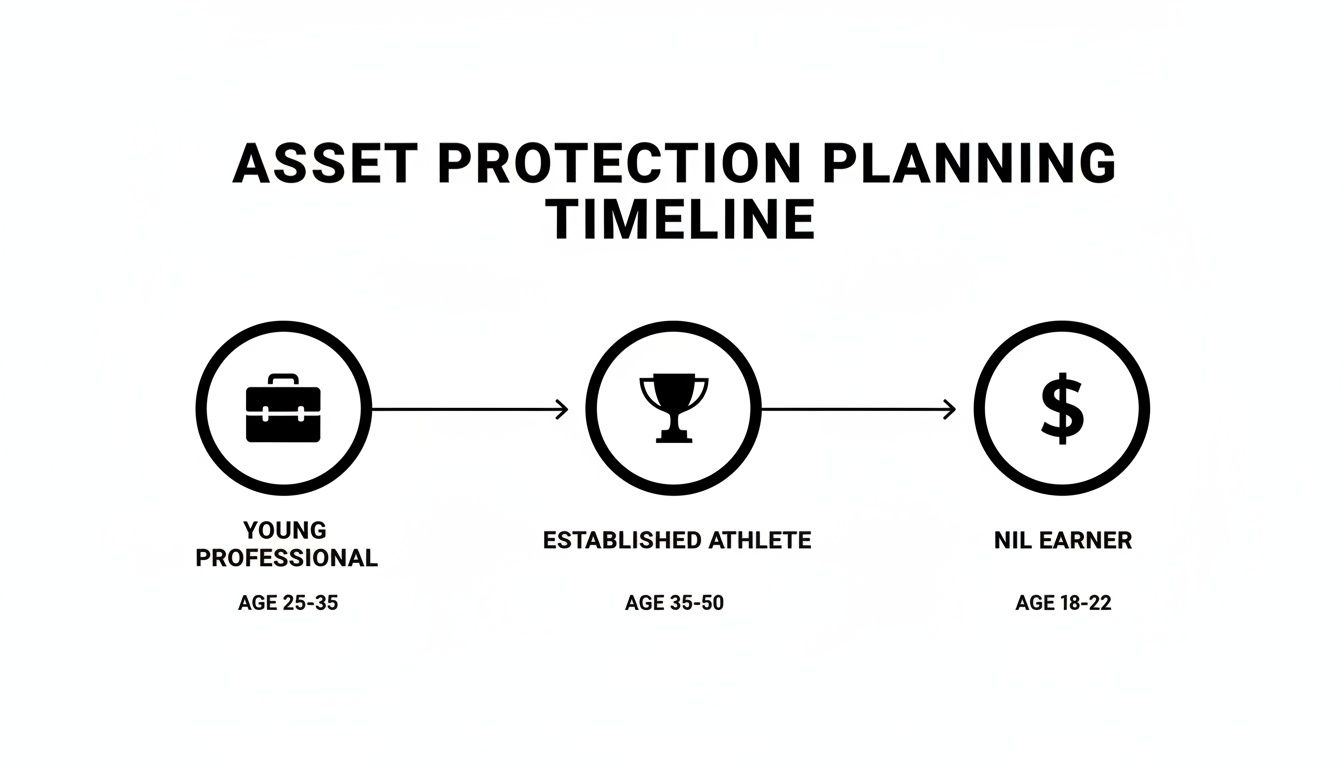
The key takeaway is that planning isn't a one-time thing. It’s a process that should adapt as your life changes.
Now let's talk about Jamal, a 22-year-old who just signed his first major league contract. He went from being a college student to a multi-millionaire overnight. The sudden wealth is amazing, but it also puts a giant target on his back.
Jamal faces risks from every angle, things like bad investments, sketchy lawsuits, and pressure from friends and family. His career is also short, meaning this money has to last a lifetime. His plan has to be aggressive and immediate.
For a pro athlete, the biggest financial risk isn't just losing money; it's how fast it can happen. A solid plan from day one is the only way to protect a short, high-earning career.
Here’s his playbook:
Finally, there's Maya, a star university volleyball player who is starting to earn significant income from Name, Image, and Likeness (NIL) deals. It's not pro-level money yet, but it’s more cash than she’s ever handled.
The challenge for Maya is that her income is unpredictable, and she's still a student trying to balance school, sports, and now, a business. Her goal is to use this opportunity to build a foundation, not just for short-term spending.
Here’s how Maya can structure her deals to protect herself:
While everyone’s situation is unique, these examples show how different priorities call for different strategies. Here’s a quick look at how the main focus shifts depending on who you are.
| Audience | Top Priority | Key Strategy | Common Mistake to Avoid |
|---|---|---|---|
| Young Professional | Foundational Protection | Umbrella Insurance, Proper Home Titling | Assuming a 401(k) is the only protection needed |
| Pro Athlete | Immediate & Advanced Shielding | Irrevocable Trusts, Loan-Out Corps, LLCs | Waiting too long to build a professional team |
| NIL Student-Athlete | Separation & Business Structure | Single-Member LLC, SEP IRA, Cash Management | Mixing personal and business funds |
Ultimately, the goal is the same for everyone: create layers of defense that make sense for your specific level of risk and wealth. The right plan doesn't just protect what you have, it gives you the confidence to keep growing it.
A plan is just a piece of paper until you actually do something with it. So, let's get into the details of turning your asset protection strategy from an idea into a reality. This isn’t about getting lost in dense legal paperwork; it's about taking clear, confident steps to get everything buttoned up.
Think of this as your "get started" guide. We’ll walk through a simple timeline, talk about keeping things legit with compliance and taxes, and most importantly, show you how to spot the red flags of a sketchy plan.
You've worked too hard to let a bad strategy mess up your goals. This is all about moving forward the right way.
Getting started with asset protection doesn't have to be some overwhelming, months-long project. You can break it down into a totally manageable timeline. The key is to just start moving.
Here’s a realistic flow from day one to your first annual check-in:
The single biggest mistake people make is failing to fund their trust or LLC. Signing the documents gives you a false sense of security, but if your assets aren't legally inside the structure, it offers zero protection when you need it most.
Let's be real: the world of asset protection has its fair share of shady operators promising the impossible. A legit strategy is about legal compliance and risk reduction, not hiding money or evading taxes. Knowing the difference can save you from a legal nightmare.
You need to be able to tell a solid plan from a total scam.
If you hear any of the following, you should probably walk away, and fast. These are major red flags that signal you might be dealing with an illegal scheme, not a sound asset protection strategy.
Ultimately, building a team you trust is everything. Getting guidance on this journey is key, which is why understanding the role of a professional is so important. If you want to dive deeper into what that relationship looks like, check out our guide on what is financial coaching to see how an expert can help you stay on the right track.

Alright, let's tackle some of the most common questions that come up when people first start looking into asset protection. It's totally normal to have a bunch of "what ifs" and "is this for me?" moments.
We've rounded up the top questions to give you some straight-up answers. No fluff, just the info you need to feel more confident about the whole process.
Honestly, the best time to start was yesterday. The second best time is right now. The absolute worst time? After you've been served with a lawsuit.
There's a legal concept called "fraudulent transfer" (or "fraudulent conveyance"). This means you can't just scramble to move your assets into a trust or LLC after a legal claim pops up, hoping to shield them. A judge will see right through that, undo the transfer, and leave your assets completely exposed.
Proactive planning is the only way this works. You have to build your fortress long before you see storm clouds on the horizon.
This is a huge misconception. Legitimate asset protection has nothing to do with hiding money or evading taxes. It’s all about using established, legal structures to organize your finances in a way that minimizes risk.
Think of it this way: locking your front door isn't "hiding" your TV from burglars. It's just a smart, legal, and responsible step to protect what's yours. Asset protection works the same way for your finances.
Everything should be fully transparent and compliant with the law. We're talking about creating legal barriers, not illegal hiding spots.
The single most common, and costly, mistake is failing to properly fund the plan. People go through all the trouble of setting up a trust or an LLC, they sign the documents... and then they stop.
An empty trust is just a worthless pile of paper.
You have to legally transfer your assets into the name of the new entity. This means retitling bank accounts, investment portfolios, and property deeds. If you skip this critical step, your plan offers exactly zero protection when you actually need it.
The cost can vary a lot, depending on how complex your situation is. Setting up a simple LLC for a side hustle might only run a few hundred dollars. A sophisticated plan with multiple trusts and offshore components, on the other hand, is a more significant investment.
But here’s how you should think about it: what’s the potential cost of not having a plan? A single lawsuit could wipe out everything you've ever worked for.
The final price tag usually includes a few things:
The investment you make in a solid plan is almost always just a tiny fraction of the wealth it's designed to protect.
At Financial Footwork, we empower you to build financial confidence through clear, actionable education and coaching. Whether you're an employee, an athlete, or a student, our programs are designed to turn complex money concepts into real-world wins. Learn more about how Financial Footwork can help you take control of your financial future.