
Your Cart is Empty


Measuring employee engagement isn't a one and done task. It’s a strategic game plan that kicks off with defining your goals, picking the right methods, and then actually committing to action. Think of it as creating a clear roadmap to understand what's really happening with your team.

So, you want to measure employee engagement, but where do you even begin? It’s about a lot more than just blasting out a survey and hoping for the best. Nailing your strategy before you dive in is the most important part of the whole process.
It’s like setting your destination in a GPS before you start driving. Without a clear "why," you're just collecting a bunch of random data points that don't lead anywhere useful. This is your chance to make sure you're asking the right questions from the very start.
First things first: you need to figure out exactly what you’re trying to solve. Are you noticing that a lot of your best people are leaving? Or maybe things are going pretty well, but you’re looking for ways to make your culture even stronger.
Your reason for measuring engagement will shape everything that comes after. So, get specific. Instead of a vague goal like "improve engagement," aim for something more focused, like:
A solid plan means you'll collect data that is actually useful instead of just creating more work for everyone. It turns measurement from a task into a powerful tool for change.
This simple flowchart breaks down the core steps: define your purpose, set clear goals, and then build your plan from there.
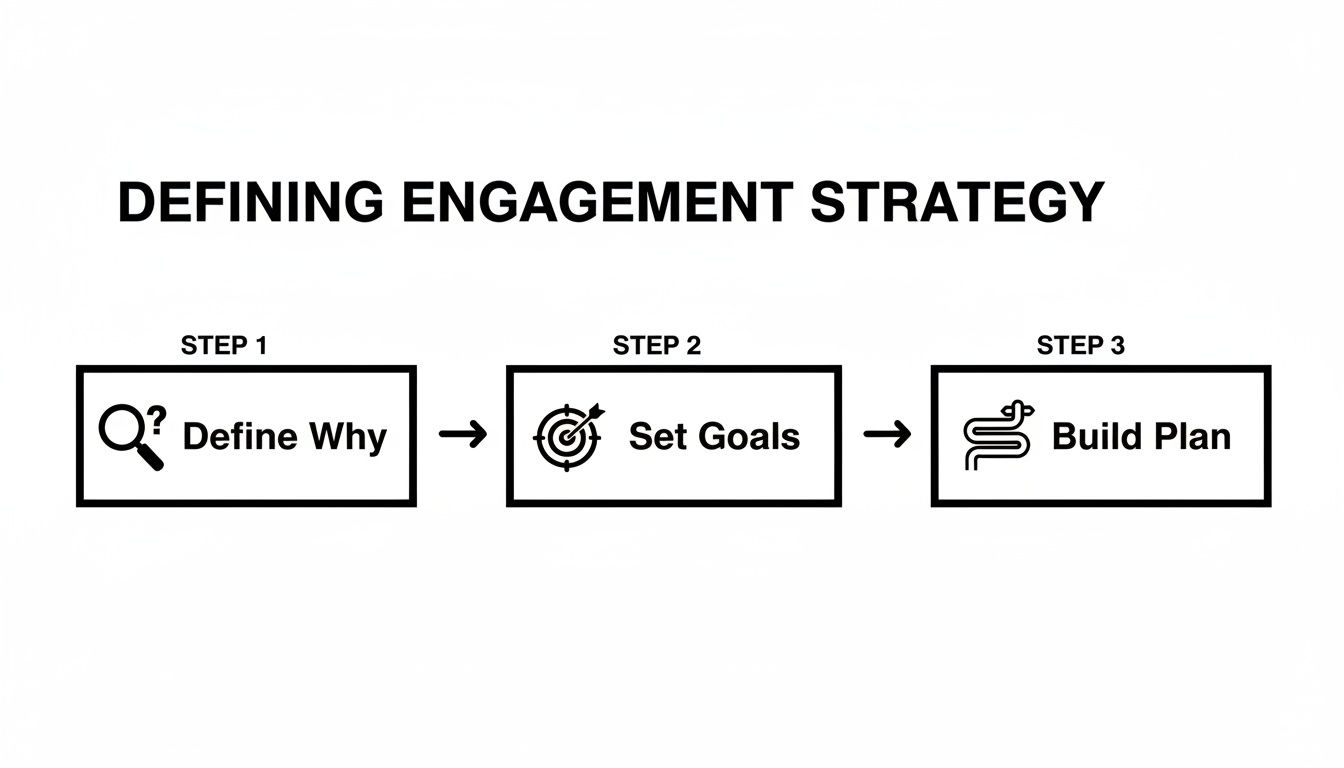
This visual makes it clear, a successful strategy is always built on a strong foundation of purpose.
Skipping this initial planning phase isn't just inefficient; it's expensive. Recent data shows that global employee engagement dropped to just 21% in 2024. That dip costs the world economy an estimated $438 billion in lost productivity. Clearly, getting this right has a massive financial impact.
Knowing your goals helps you focus your efforts where they'll make the biggest difference. If turnover is your main problem, understanding employee retention best practices is a great place to start your research. A targeted approach ensures you’re not just measuring for the sake of it, but are actively working to solve real business challenges.
You've figured out why you're measuring engagement. Now, let's get into the how. This is all about picking the right tools to get a full, honest picture of what’s happening with your team.
Think of it this way: you can't solve a puzzle with just one piece. The best approach always mixes two types of feedback: quantitative data (the hard numbers) and qualitative data (the stories behind the numbers).
The numbers tell you what is happening. The stories tell you why. You absolutely need both to understand the real vibe of your organization.
Quantitative tools are all about collecting data you can count, track, and measure. They’re perfect for spotting trends over time, benchmarking progress, and seeing how different departments or teams stack up. The go to tool here is, of course, the survey.
Annual Surveys: These are your deep dives. You send them out once a year to get a comprehensive look at everything from leadership effectiveness and compensation to career growth opportunities. They’re fantastic for setting a solid yearly benchmark.
Pulse Surveys: Think of these as quick, regular check ins. They’re short and sweet, just a handful of questions sent out monthly or quarterly. Because they're so fast, you get a real time "pulse" on employee sentiment and can jump on issues before they escalate.
eNPS (Employee Net Promoter Score): This is the simplest of them all. It boils down to one powerful question: "On a scale of 0-10, how likely are you to recommend this company as a place to work?" It gives you a single, potent metric to track loyalty and advocacy over time.
Numbers alone only get you so far. To really dig in and understand what’s driving your scores, you need to hear from people in their own words. This is where qualitative methods come in, and they are pure gold for adding context to your survey data.
Qualitative feedback is what turns a spreadsheet of scores into a human story. It's where you'll find the specific, actionable ideas that surveys can sometimes miss.
A few of the most powerful qualitative tools include:
One-on-Ones: Those regular check ins between a manager and their direct report are priceless. When done right, they create a safe space for honest feedback about everything from workloads and career goals to any roadblocks that are getting in the way.
Focus Groups: Getting a small, diverse group of employees together for a guided discussion can uncover insights you’d never get from a survey. This is a great way to explore a specific topic in depth, like a new company policy, team dynamics, or benefit offerings.
'Stay' Interviews: Instead of waiting for an exit interview to find out why people leave, a "stay" interview proactively asks your top performers what keeps them here. It’s a brilliant way to learn what you’re doing right. This can reveal surprising insights, like how much they value specific benefits. For example, some might highlight the impact of programs that reduce financial stress. You can learn more about impactful benefits like financial wellness apps in our article.
Building a complete toolkit with both quantitative and qualitative methods ensures you're not just guessing. You're getting a clear, 360-degree view of what truly drives your team's motivation and commitment.

Let's be real, nobody gets excited about a bland, 50-question company survey. Most of us just click through to get it over with, which hands leaders totally useless data. The secret to getting good feedback isn't complicated: design a survey people actually want to complete, or at least don't mind filling out.
This means keeping it clear, concise, and focused on what really matters. When you ask sharp questions that get to the heart of issues like psychological safety, career growth, or feeling valued, you prove to your team that you’re genuinely listening. A well designed survey builds trust and gets you the honest answers you need to make real changes.
The way you word your questions makes all the difference. You have to steer clear of leading or biased language that nudges people toward a certain answer. For instance, instead of asking, "Don't you agree our new wellness program is great?" try something neutral like, "How valuable do you find the new wellness program?"
Mixing up question types is also a great strategy for keeping people engaged.
Likert Scale Questions: These use a simple scale like "Strongly Disagree" to "Strongly Agree." They're fantastic for getting quick, measurable data on specific topics, like "I feel my manager supports my career growth."
Open-Ended Questions: Questions like, "What is one thing we could do to improve team communication?" are absolute goldmines. They give you the "why" behind the numbers and often reveal blind spots you never would have thought to ask about.
The goal isn't just to get responses; it’s to get thoughtful, honest responses. Making the survey anonymous is non-negotiable here. People will only share their real thoughts if they feel safe from any kind of blowback.
To gather truly meaningful data, understanding the right must-ask employee engagement questions is critical. This gives you a solid starting point for crafting questions that get to the core of what drives your team.
Below are some examples of questions you can adapt, broken down by the specific engagement driver they're designed to measure.
| Engagement Driver | Sample Question (Likert Scale 1-5) | Why It Matters |
|---|---|---|
| Manager Support | "I receive regular, constructive feedback from my manager." | Direct managers have the single biggest impact on an employee's daily experience. |
| Career Growth | "I see a clear path for professional development at this company." | A lack of growth opportunities is a top reason talented people leave. |
| Recognition | "I feel recognized and appreciated for my contributions." | Feeling valued reinforces positive behaviors and boosts motivation. |
| Psychological Safety | "I feel comfortable sharing my opinions, even when they differ from others." | Teams can't innovate or solve problems if people are afraid to speak up. |
| Work-Life Balance | "I am able to disconnect from work after hours." | Burnout is a primary driver of disengagement and turnover. |
These questions are just a starting point, of course. The key is to tailor them to your organization's unique culture and the specific goals you've set for your engagement program.
Your team’s time is valuable, so respect it. A survey that drags on forever is a surefire way to get low-quality, rushed answers. As a rule of thumb, aim for a survey that can be completed in 10-15 minutes max.
A good structure helps the experience feel less like a chore. Group related questions together, for example, create a section on leadership, another on work-life balance, and a third on career development. This logical flow makes the survey much smoother for the employee.
Ultimately, a shorter, more focused survey sent more frequently is way better than a massive annual one that everyone dreads. You get better data, and your team feels like their feedback is part of an ongoing conversation, not a once-a-year obligation.

So, the survey responses are in. This is where the real work begins, turning a mountain of raw data into a story that makes sense. Staring at a spreadsheet full of numbers and comments can feel overwhelming, but this is the step where you connect the dots and figure out what’s really going on.
The goal here is to move beyond just reporting numbers and uncover genuine insights. An insight is that "aha!" moment when you realize why a score is low, or what’s truly driving all those comments about communication breakdowns.
Your first pass at the quantitative data should be all about spotting patterns. Don't just get fixated on the overall company score. The most powerful stories emerge when you slice the data and compare different groups within your organization.
Start by looking for trends over time. Did engagement scores in the marketing department take a nosedive last quarter? Or maybe you see a spike in positive feedback right after launching that new mentorship program. These are the clues that tell you what’s working and what isn’t.
A fantastic metric for this is the eNPS (Employee Net Promoter Score). It’s a simple, powerful score based on one question: "On a scale of 0-10, how likely are you to recommend our company as a great place to work?" It automatically sorts your team into three camps:
To get your eNPS, you just subtract the percentage of Detractors from the percentage of Promoters. Tracking this single number over time is one of the fastest ways to get a pulse on overall morale. If you want to get into the nitty-gritty of crunching the numbers, this guide on how to analyze survey data in Excel is a great resource.
The real magic happens when you pair the numbers with qualitative feedback from interviews and open-ended survey questions. This is how you discover why the tech team’s eNPS dropped by 15 points or what’s behind the sales team’s glowing reviews.
Don't get bogged down trying to analyze every single word. The trick is to look for recurring themes. As you read through comments, start tagging them with keywords like "career growth," "manager support," "work-life balance," or "recognition." Before you know it, you'll start to see which topics are popping up again and again.
Pulling out a few powerful, anonymous quotes can bring your data to life in a way that numbers alone never could. A statement like, "I have no idea what the career path is for my role," is infinitely more impactful than simply reporting that "career growth scored a 3.2 out of 5."
Once you’ve identified your key findings, resist the urge to dump everything into a 50-page report that no one will read. Instead, create a simple, visual dashboard that tells a clear story. It should be easy to understand at a glance and highlight the most critical takeaways.
Your dashboard should feature things like:
This approach makes it so much easier to share what you've learned with leadership and, just as importantly, with the rest of the company. You’re not just presenting data; you’re starting a conversation that leads to real, meaningful change.
Okay, let's talk about the most important step in this whole process, and honestly, it’s where most organizations completely drop the ball.
You can have the slickest surveys and the most detailed data, but if you don't do anything with the results, you’ve just wasted everyone's time. Seriously. Measuring engagement is pointless if it doesn't lead to actual change.
This is all about turning those numbers and comments into a real, concrete action plan that moves the needle. Without this step, you risk teaching your team that their feedback doesn't matter, which is way worse than not asking at all.
When you get your results back, it’s incredibly tempting to want to tackle every single issue at once. The data might point to problems with manager support, career paths, and work-life balance all at the same time.
Trying to solve everything is a surefire way to solve nothing.
Instead, you have to prioritize. Look for the low-hanging fruit and the high-impact areas.
Pick two or three key focus areas for the next quarter. This focused approach makes your goals feel achievable and shows your team you're serious about making progress.
The worst thing you can do after a survey is radio silence. It creates suspicion and kills trust faster than anything else. Being transparent, even with not-so-great news, shows respect for your team's honesty.
Once you've prioritized, it's time to communicate the findings. And no, a single company-wide email from HR isn't going to cut it. You need to share the results transparently, team by team.
This is where managers become your most valuable players. Equip them with their team-specific results and guide them on how to lead a discussion. The goal isn't for managers to present a pre-made plan from the top down. It's about co-creating solutions with their teams.
This might look like a team brainstorming session where you ask questions like:
This approach does two amazing things. First, you get way better, more relevant solutions because they come directly from the people doing the work. Second, it gives everyone a sense of ownership over the plan, which dramatically increases the chances it will actually stick.
If feedback points to financial stress as a major concern, it could be a perfect opportunity to explore new resources. You can learn more about how to provide practical financial education for employees to see if it fits your team's needs.
Finally, remember that this isn't a one and done project. Measuring and acting on engagement is a continuous cycle of listening, acting, and then listening again.
After you implement changes, use your next pulse survey to check in. Did the needle move on the areas you focused on? This follow up is critical. It closes the feedback loop and turns engagement from an annual task into an ongoing conversation about making your workplace better for everyone.

Alright, you've got the playbook, but a few questions are probably still bouncing around in your head. That’s perfectly normal. Let's dig into some of the most common things that come up when leaders start measuring engagement for the first time.
Think of this as a quick FAQ to help you navigate some of the trickier parts of building a program that actually works for your people.
This is a big one. You don't want to bombard your team with surveys every other week, but waiting an entire year between check ins is a recipe for disaster. Things just move too fast for that.
The sweet spot is usually a hybrid approach. Run a comprehensive, deep dive survey once a year to get a solid benchmark. Then, sprinkle in shorter, quarterly pulse surveys to keep a finger on the, well, pulse of how your team is feeling in real time. This strategy gives you consistent data without driving everyone nuts with survey fatigue.
Don't ask for feedback if you aren't prepared to listen to it and do something about it. The worst thing you can do is ask, get tough feedback, and then go silent.
This rhythm shows you’re listening all year round, not just when it’s time for performance reviews. It turns feedback into a real, ongoing conversation.
First things first: don't panic. Negative feedback isn’t a sign of failure, it’s a gift. Seriously. It means your team trusts you enough to be honest about what’s broken, which is infinitely better than them quietly checking out and updating their resumes.
What you do next is absolutely critical. Here’s the game plan:
This approach proves you’re not just hearing the feedback; you're actually acting on it.
Getting your managers bought in is a total game changer. Some will see this as just another item on their already packed to do list, so you need to frame it in a way that shows them what's in it for them.
Position the engagement data as a powerful tool that makes their jobs easier. It gives them concrete insights into what motivates their team, what roadblocks are getting in the way, and how they can become a more effective leader. Give them their own team specific reports and, crucially, coach them on how to talk about the results.
Once managers realize this data helps them build a stronger, more productive team, they'll become your biggest champions.

Building a culture where employees feel supported and heard is a marathon, not a sprint. At Financial Footwork, we specialize in programs that tackle one of the biggest hidden stressors for any team: money. Our financial wellness education can boost engagement by giving your people the confidence to manage their financial lives. Learn more about how we can partner with you at https://financialfootwork.com.